Dealing with business documents is more complicated now than it has ever been. Companies are constantly generating digital files, contracts, bills, employee records, and customer documents that have to be managed. Without a good system in place, locating the correct document at the right time is a real problem that causes a drop in productivity and non-compliance.
This is exactly where Document Management Software (DMS) and Enterprise Content Management (ECM) come to the rescue. Even though these are frequently treated as synonyms, they are actually quite distinct. Clarifying the distinction between ECM and DMS allows companies to make an educated decision when purchasing the best solution tailored to their operations, scale of document handling, and vision for future expansion.
Through this post, we’re going to unveil the definitions of ECM and DMS, major distinctions, features of each, and what type of solution matches perfectly with your workplace.
What is Document Management Software (DMS)?
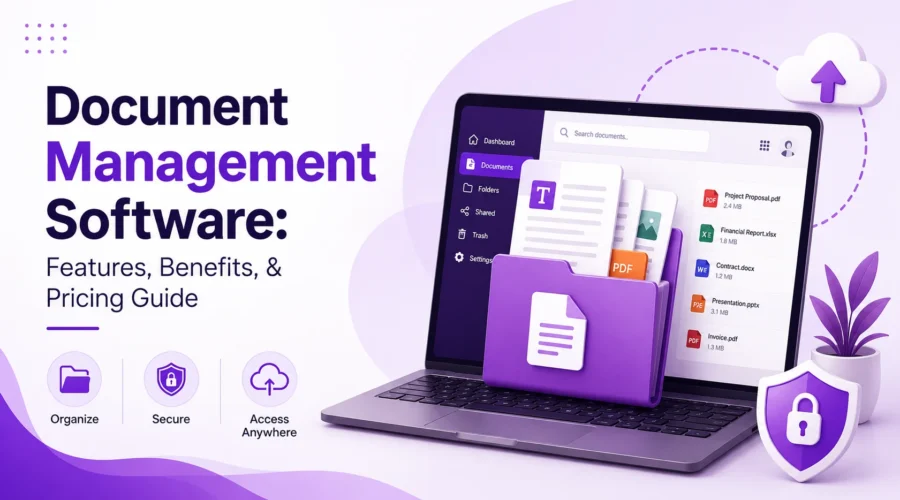
‘Document Management Software’ (DMS) refers to a digital tool whose main purpose is to manage documents. Through this one system, you will be able to store your documents, organize them, find the files you need, and manage them easily.
Rather than keeping paper files or folders on various devices, companies have the option of putting all documents securely in a single system where the users have right of access can search for files, edit, and share them quickly.
Common Features of Document Management Software
-
Centralized document storage
-
Advanced search functionality
-
Version control
-
Role-based user access
-
Document sharing
-
File indexing
-
Audit trails
-
Secure cloud or on-premise storage
Document management software is well suited for companies that want to cut down on paperwork and keep their documents organized through a single solution.
What Is Enterprise Content Management (ECM)?
Enterprise Content Management (ECM) is a broader business strategy and technology system that deals with the management of organizational content—not only documents.
Document management is included in ECM, but ECM also goes beyond it by controlling the way information is created, captured, processed, stored, shared, archived, and disposed of throughout its lifecycle.
At the same time, ECM is able to handle documents and make them work together with business workflows, compliance requirements, collaboration tools, and automation processes.
Enterprise Content Management Shared Features
-
Document management
-
Workflow automation
-
Business process management
-
Records management
-
Digital asset management
-
Compliance management
-
Content lifecycle management
-
Enterprise-wide collaboration
Enterprise content management software allows corporations to handle data through various departments and boost productivity and compliance simultaneously.
Key Benefits of Document Management Software
Compared to companies that rely on traditional means for managing their papers, a business that is a beneficiary of document management software would
Improved Document Organization
Files retain good organization, and it’s easy to search for them and access them.
Faster Retrieval
Staff do not have to lose hours trying to locate documents because they will instantly have the right one from their screen.
Enhanced Security
The use of user roles and the associated permissions guarantees users will not share confidential materials with others unless it’s their business.
Version Control
Everybody always works on current versions; there is no duplication of documents, and nobody works on a different version than others.
Reduced Paper Usage
By digitizing document management, a physical paper requirement is virtually reduced to zero, and so will paper-related costs be.
Key Benefits of Enterprise Content Management
Besides the basic advantages, companies that require a systemwide approach to managing their information can expect to get more out of an enterprise content management system.
Business Process Automation
With an enterprise content management system, you automate the different processes, like approvals and notifications, besides routing and handling repetitive tasks.
Better Compliance
The main features of the enterprise content management software make it a good option for regulatory compliance by providing functionalities like audit trails, retention policies, and secure access controls.
Centralized Information Management
One enterprise platform helps with the management and sharing of documents produced in different areas of the organization.
Increased Productivity
Collaboration is made simpler for employees as they do not have to go to different tools for their tasks.
Scalability
The ECM system is able to adapt to the changing needs and growth of the business as it evolves to support the development of the company.
ECM vs. DMS: Which One Should You Choose?
The right choice depends on your business size, operational complexity, and future goals.
Choose document management software if you:
-
Need secure digital document storage
-
Want faster document retrieval
-
Manage mostly files and records
-
Operate a small or medium-sized business
-
Want a cost-effective document management solution
Choose Enterprise Content Management if you:
-
Manage large volumes of business content
-
Need workflow automation
-
Require compliance management
-
Have multiple departments handling shared information
-
Need enterprise-wide information governance
Can a DMS become an ECM system?
Absolutely.
Document management software is a common part of an enterprise content management system.
Initially, many companies only use DMS for document archiving. Yet, with a growing need for business automation, these companies step-by-step begin integrating ECM systems by including document workflow automation, records management, compliance, and collaboration modules.
This step-by-step approach gives companies flexibility for their information management strategy expansion without getting rid of their current systems.
Frequently Asked Questions
1. What is the main difference between ECM and DMS?
Document Management Systems (DMS) mainly focus on the management of documents through storing, organizing, and retrieving files. Still, Enterprise Content Management (ECM) is the management tool that deals with all content of the enterprise, including document workflows, records, emails, and business processes.
2. Is document management software suitable for small businesses?
Absolutely. Small and medium-sized companies that require secure document storage, easy file retrieval, and efficient teamwork can very well go for document management software without encountering the complexities of a full-scale ECM platform.
3. Can Enterprise Content Management improve business productivity?
Really. Enterprise Content Management can help a lot in enhancing workflow efficiency, reducing repetitive tasks manually by automation, and encouraging collaboration, thereby helping the teams to work at their highest productivity.
4. Can I upgrade from DMS to ECM later?
Yes, it’s totally feasible. Starting with DMS is quite common for many companies, and then gradually adopting ECM when the document volume, compliance needs, and business processes start to increase in complexity is also quite common.
Conclusion
It is really important to know the difference between DMS and ECM before selecting document management software for your company.
On one hand, document management software is meant to manage your documents with features like organization, storage, security, and retrieval. But an enterprise content management system covers the entire spectrum of content life cycles and also handles workflows, compliance information, etc. throughout a company. Usually, small and medium companies start with DMS during the initial phase of their digital transformation.
Bigger companies, which have complex operations, need compliance, and are looking to collaborate across departments, would probably find a complete enterprise content management system solution much more suitable. Ultimately, your choice should be based on what you want for your business, what your company can handle operationally, and how you plan to grow.