Nowadays, businesses interact with many records and data through digital channels every single day. A good management strategy for those documents can yield benefits such as getting tasks done faster, cutting down on paperwork, and easier sharing of updated info. A digital document management system (DMS) will assist companies to arrange and save their papers in electronic format. Besides that, document indexing is a vital factor in referring to documents in a quick and competent way.
Document indexing serves an essential role in digital document management systems, as it supports the categorisation, organisation, and fast retrieval of files. In the absence of reliable indexing, locating key documents among a large database can become very time-consuming and impossible.
What Is Document Indexing?
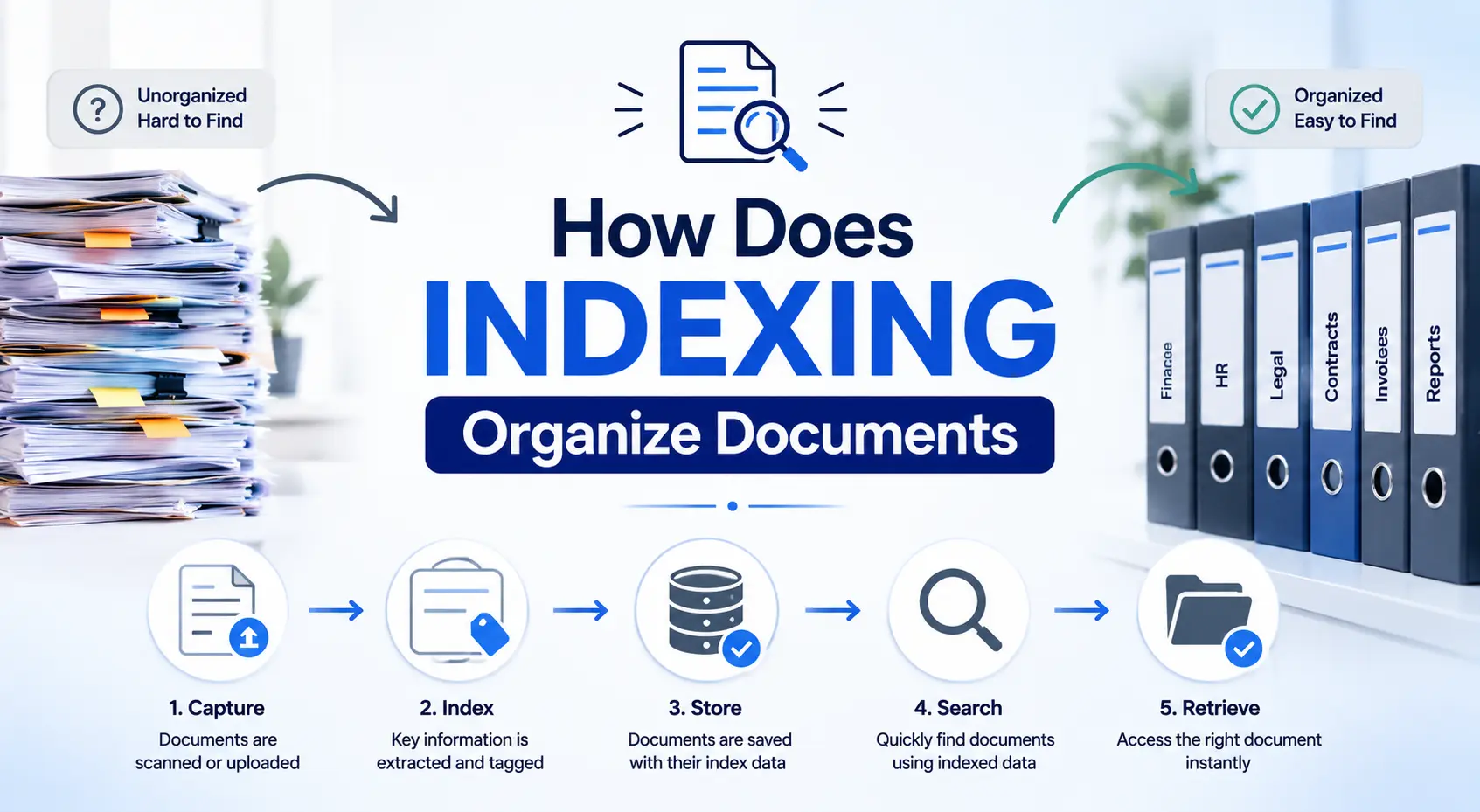
‘Document indexing’ refers to the procedure of attaching relevant keywords, tags, numbers, or categories to documents for easy searching and retrieval at a later time. Essentially, it is a systematic filing method for digital documents.
For example, invoices can be indexed based on invoice numbers, customer names, dates, or department names. In this way, users can find a specific document in a snap without the need for a manual folder search.
Improves Document Search and Retrieval
Indexes enable document search and retrieval to be faster and more efficient, which is mainly the objective of indexing in digital document management. One can quickly locate the indexed documents by using keywords or search filters.
The use of paper files or unorganized folders for hours looking for the desired documents is history. Indexing properly is one of the business keys to finding and accessing important records in seconds, saving a lot of time and operational efficiency.
Enhances Organization of Documents
With the help of indexing, companies can have a neat and orderly document management system. For example, documents can be assigned to categories like departments, project names, dates, clients, or types of documents.
Such a systematised arrangement decreases the risk of confusion and makes certain that the whole set of files is stored in a systematic way. If a system has been correctly focused on indexing, it will also be very likely to reduce document loss.
Increases Productivity
When people get the information they need instantly, the productivity of a workplace will definitely go up. With document indexing, not only is the manual work brought down, but also people will be freed to do more business-orientated tasks other than just searching for files.
Quick access to documents will also help with communication and decision-making in the company.
Supports Better Data Accuracy
Proper indexing reduces the risk of duplicate records and misfiling. Enterprises can keep their records accurate and enhance their overall data management process.
Besides, accurate document indexing alongside methodical filing also diminishes human errors that can be introduced during manual document handling and filing.
Strengthens Security and Compliance
Many digital document management systems are equipped with access control and security features. Through proper permissions, users can manage indexed documents so that the only ones with access to sensitive information are authorized individuals.
Besides, indexing contributes to meeting industry regulations because it makes records readily available for tracking, auditing, and retrieving when necessary.
Saves Storage Space and Costs
Traditional paper-based filing systems need a lot of physical space to store files and incur continuous maintenance costs. Digitally managing documents with indexing cuts down on paper usage and keeps storage costs to a minimum.
Companies are able to keep thousands of indexed documents electronically and at the same time provide their employees with easy access to records whenever they want.
Simplifies Workflow Management
Documents with an index help in streamlining workflow automation as the files easily get transferred from one department to another & approval. The employees can efficiently find and share the documents, which increases collaboration and workflow efficiency.
This is very important for industries like healthcare, finance, legal services & government organisations where managing documents is of utmost importance.
Conclusion
Document indexing is very important in digital document management, as it enhances document organisation, searchability, accuracy, and security. It enables businesses to reduce time wastage, raise their productivity levels, and more effectively manage their records.
With digital transformation being the trend of the day, more and more businesses are using document indexing as a way of streamlining their operations and making information retrieval easier.